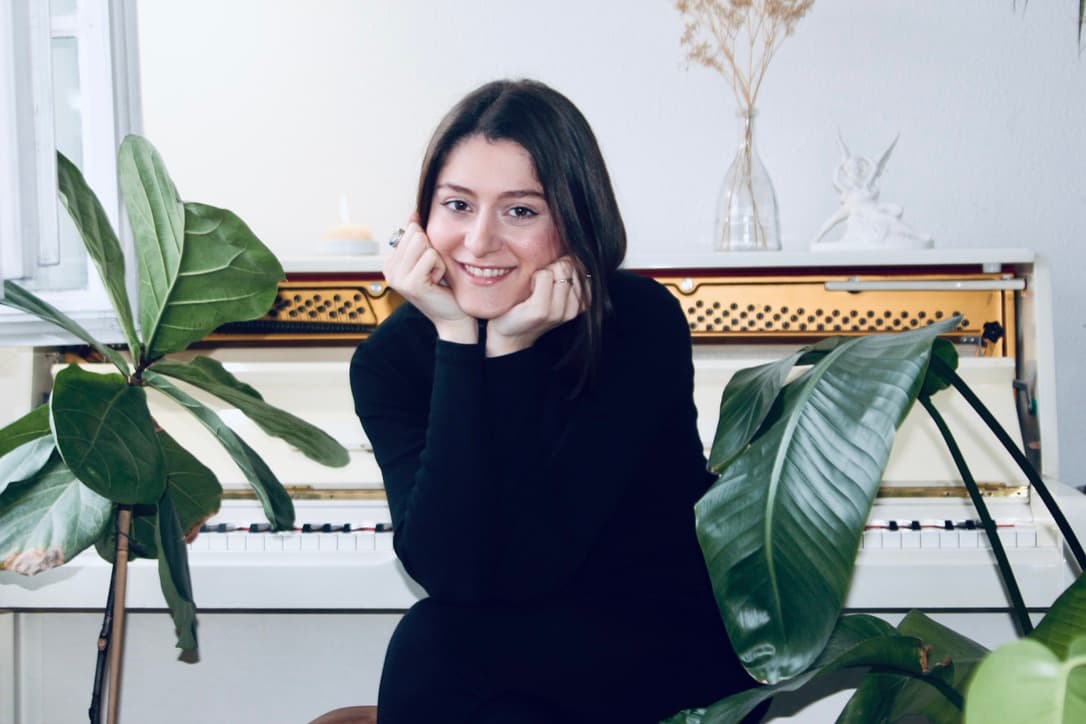
Private Piano Lessons in Hamburg Beat Apps and Groups
April 28, 2026·6 min read·Ceren Ece Soyer
Curious to try this yourself?Book a Trial LessonThere is a study that music education researchers keep coming back to, one conducted in the early 2000s by a team at the Royal College of Music in London. They wanted to understand why some students made rapid, lasting progress while others — equally motivated, equally intelligent — seemed to stall. They filmed hundreds of practice sessions. They interviewed teachers. They followed students over years. What they found surprised them: the gap wasn't practice time. It was feedback frequency. The students who improved fastest were the ones who received specific, immediate correction most often. Not encouragement. Correction.That finding doesn't get nearly enough attention in the way we talk about music education today.Every few months I get a message from someone who tried a piano app for six months and stalled. Or someone who sat through a group music class and came out knowing how to clap a rhythm but not how to play a song. They're not asking for a sales pitch. They're asking whether it's worth trying something different.Here is my honest answer, from someone who has taught piano for over a decade, in Hamburg since 2024.
What an App Cannot Hear
The fundamental problem with learning piano from an app — and it is a structural problem, not a design flaw — is that an app cannot hear you.This sounds obvious until you understand what hearing actually does in a lesson. When I watch a student's hands, I notice things the student cannot: the right shoulder tensing slightly before a difficult passage, the wrist dropping on the descent, the finger that lifts too early and disrupts the legato. Most of the physical habits that hold piano players back are invisible to the person who has them. They accumulate silently, reinforcing themselves with every repetition, and they are profoundly difficult to unlearn once set.The moment of correction — "your wrist is dropping, let it float" — interrupts that loop before it becomes permanent. Apps can grade you on rhythm. They can tell you whether you hit the right note. They cannot tell you that you're building a tension pattern that will limit you for years.Group classes have the same problem, only in a different form. A teacher split across fifteen students is making constant triage decisions: who needs attention most urgently right now? The student with a subtle postural issue who is otherwise keeping up will wait. And wait. And eventually ingrain the habit so deeply it becomes part of how they play.
The Curriculum That Starts With You
In 2019, a music educator named Gary McPherson published a long-form study on adult beginner motivation in instrumental learning. His central finding was straightforward and devastating for standardized music programs: adults abandon instruments not when they find them difficult, but when the difficulty feels disconnected from what they actually want to play.A retired engineer learning piano for the first time has different goals than a 10-year-old preparing for a school concert, or a singer who wants to accompany herself at open mic nights in Altona. These are not minor variations in the same need. They are fundamentally different projects.Group classes and apps work from a fixed curriculum that moves at the group's pace. There is no mechanism for skipping what a particular student already understands, or slowing down at the exact passage where her coordination breaks down, or taking a three-week detour into jazz harmony because that's where her curiosity is pulling her. Private lessons can do all of those things. And the willingness to do them is not a luxury feature — it is the core of why lessons work.This is why repertoire matters so much more than most people realize. In a private lesson, we choose music together — music that fits the student's taste, level, and goals. I've had adult students start with a Beethoven bagatelle they've loved for twenty years. I've had teenagers who wanted to learn the piano part from a song their band was already playing. Learning something you actually care about does not just increase enjoyment. It increases the quality and consistency of home practice, which is where most of the actual learning happens.
What a Teacher Knows by Month Three
There is a kind of knowledge that accumulates slowly and cannot be rushed.By the third or fourth month of weekly lessons, I know things about each of my students that no app or group teacher could know: that one student's rhythmic steadiness collapses under pressure but is solid in calm run-throughs, and so she needs to practice at performance tempo early; that another student jumps between hand positions confidently but loses his place after rests, which means his internal pulse needs work; that a particular adult learner in Winterhude freezes when she makes a mistake and needs a specific protocol for recovery rather than repetition.I plan each lesson in advance knowing what needs attention that week, not based on where a curriculum says we should be, but based on what I observed the week before and what I know is coming. That accumulated knowledge of a specific person as a learner is the element that apps cannot replicate and that group classes can only approximate.There is a related phenomenon that rarely gets discussed: the question-asking gap. Adults especially tend to hold back in group settings. "Why does this chord feel awkward?" "Am I holding the pedal wrong?" "Will I ever be able to play fast passages?" These are exactly the right questions — the ones that, answered directly, can accelerate progress by weeks. In a private lesson, you ask them all, without the social friction of seeming slow in front of others or derailing a class. The questions are welcome. They are the lesson.
Hamburg, Logistics, and the Scheduling Reality
For families in Eppendorf, Winterhude, Eimsbüttel, Harvestehude, and nearby neighborhoods, the fixed schedule of a group class often becomes the first thing to drop when a school trip conflicts, a child is sick, or the football season starts. Once you miss two group sessions, the class has moved on and catch-up becomes its own stressor.Private lessons are easier to reschedule without academic consequence. I arrange lessons around my students' routines — early afternoons for children, evenings and Saturday mornings for adults and families. When a student needs to pause for exam season or a family trip, we adjust. When they return, we pick up exactly where we left them, with notes on what they were working on and what was starting to click.Progress is also visible in a way that group learning obscures. In a group class it is easy to drift along with a vague sense of "doing fine" relative to the other students, without that measurement meaning much. In private lessons, I keep notes on what we worked on, what to practice at home, and what comes next. Students and parents can see what's improved. That clarity sustains motivation through the slow patches that every learner encounters.
The Honest Caveat
Private lessons cost more than an app subscription and more than a group class. The price difference is real, and it would be dishonest to minimize it.What's also real is the rate of progress and the likelihood that you'll stick with it. Most people who come to me after a year with a piano app haven't stalled because they lacked discipline. They've stalled because the feedback loop was too thin, the repertoire felt arbitrary, and no one noticed the shoulder tension until it became a wall.For 45 to 60 minutes a week, what most students want is to actually play piano — not to maintain a streak, not to pass through a preset curriculum, but to sit down and play something that moves them. Private lessons are built for that specific outcome in a way that other formats structurally are not.If you're curious whether private lessons are right for you or your child, the simplest next step is a trial lesson. It's 25 minutes, no commitment, and you'll know by the end whether it's a fit.