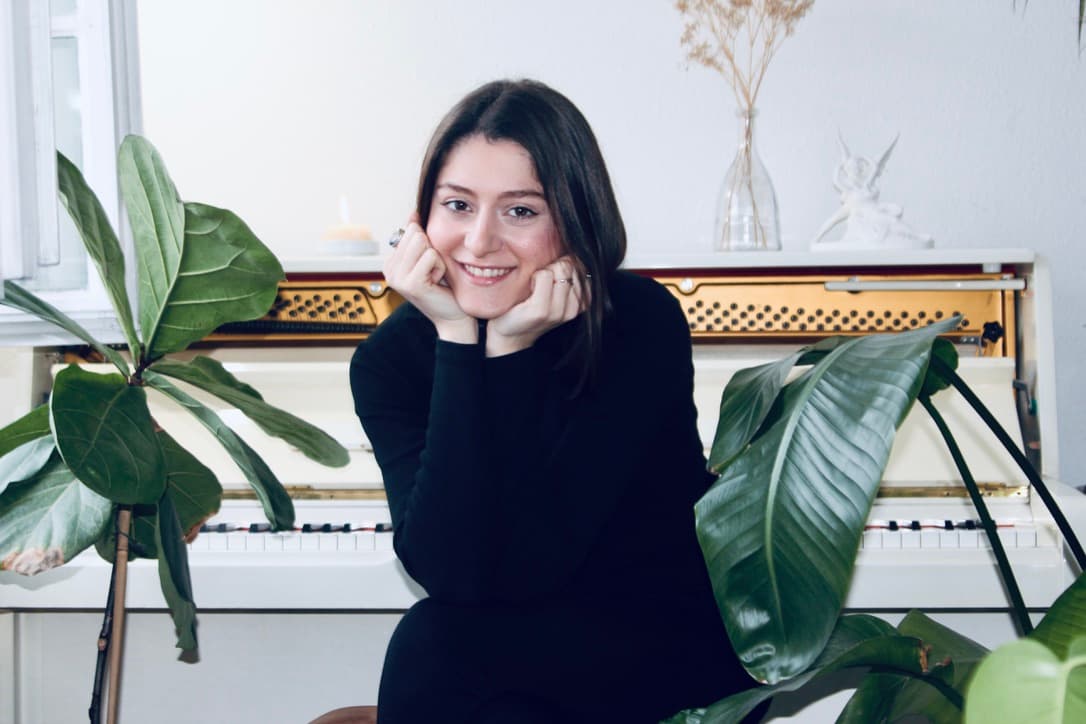
First Piano Lesson in Hamburg: Free, 25 Minutes, No Audition
June 21, 2026·5 min read·Ceren Ece Soyer
Curious to try this yourself?Book a Trial LessonA man in his early fifties sat down at the piano in my studio last spring. He was an architect — someone who builds things for a living — and his hands were shaking. Not a lot. Just enough that I noticed him press them into his knees before we started. He had booked the trial lesson three weeks earlier, cancelled once, rebooked. When he finally came through the door on Deichstraße, he said something I hear in some version almost every week: "I should warn you, I have absolutely no musical ability whatsoever."Twenty-five minutes later, he was playing a simple melody with both hands. Not beautifully. But recognizably. He looked at his own fingers like they belonged to someone else.That moment — the surprise of it — is the most reliable thing about first lessons. People come in braced for embarrassment and leave having done something they thought they couldn't do. It doesn't always look the same, but it happens with a regularity that I've stopped being surprised by.
What You Do Not Need to Do Beforehand
This is the question I get most often before a first lesson, in various forms: Should I buy a keyboard first? Should I learn to read music? Should I watch some videos so I'm not completely starting from zero?No. To all of it.You do not need an instrument at home yet. You do not need to prepare anything. You do not need to know what a treble clef is, or which key is middle C, or how to sit. I would actually prefer you didn't try to teach yourself posture from YouTube, because the first thing I'll need to do is undo whatever tension you picked up.The trial lesson is designed for someone who has never touched a piano. If you happen to have some experience — childhood lessons, a keyboard collecting dust in the spare room — that's useful context, but it's not a prerequisite. The starting point is wherever you are.
What the Twenty-Five Minutes Actually Look Like
The trial lesson is free at my studio and runs about twenty-five minutes. It is not a condensed version of a regular lesson. It is something different: part introduction, part experiment, part conversation.We start by talking. What brought you here. What you'd like to play, even if that feels vague — "something classical" or "I just want to be able to sit down and play" are both perfectly good answers. This part matters because it tells me what kind of experience you're looking for, and that shapes everything that follows.Then we go to the piano. I show you the basic geography of the keyboard — where the patterns are, how the black and white keys relate. We play something together, usually something simple enough that your hands can do it within a few minutes. This is not a test. There is no wrong answer. What I'm doing is watching how you respond to the instrument: how your hands move, how you listen, how you react when something works.By the end, we talk about what regular lessons look like — the format, the pace, what to expect in the first month. And then you go home and decide. No one asks you to commit on the spot.
What I Am Listening For
People sometimes assume the trial is an audition — that I'm silently evaluating whether they have enough talent to be worth teaching. I'm not. I've never turned someone away for lack of ability. That's not what the trial is for.What I'm actually paying attention to is more practical. How do you respond to a new physical task? Do you tense up or stay loose? When you make an error, do you stop and freeze, or do you keep going? Do you listen to the sound you're producing, or are you watching your hands? None of these observations are judgments. They're starting points. They tell me how to teach you — whether you need more structure or more freedom, whether you learn better by imitation or by explanation, whether we should start with reading or with playing by ear.The trial is diagnostic, not evaluative. I'm figuring out how to build a path that works for your specific brain and hands.
The Fears People Walk In With
After years of teaching in Hamburg, I can almost predict the first thing a new student will say. The fears cluster into a handful of categories, and they are remarkably consistent across age, background, and profession.I'm too old to start. You're not. Adults learn differently than children — more deliberately, more efficiently. I teach adults in their thirties, forties, sixties, and seventies. Many of them are my most motivated students.I have no talent. Talent is a real thing, but it matters far less than people think, especially at the beginning. The students who progress fastest are not the most naturally gifted. They are the most consistent. Fifteen minutes of daily practice outperforms innate ability every time.I tried as a kid and failed. You didn't fail. You were a child, with a child's attention span and priorities, probably taught by a method that didn't suit you. Adult learning is a completely different experience. The fact that you're here now, choosing this for yourself, changes the entire dynamic.I'll be the worst student you've ever had. You won't be. And even if you were, that wouldn't matter. Teaching a complete beginner is one of the most satisfying parts of this work precisely because the progress is so visible.
Where It Happens
My studio is on Deichstraße in central Hamburg — that's where most trial lessons take place. The studio has a good piano, decent acoustics, and no distractions. For a first lesson, it's the simplest option.But lessons don't have to stay in the studio. Online lessons remove the commute entirely, and they work well for anyone outside easy reach of Deichstraße. Home visits used to be the third option; they are currently paused while I focus my teaching capacity on the studio and online.Online lessons are also an option, and they work well for teens and adults. For younger children — roughly under eight — in-person is better. Small hands need the kind of real-time physical guidance that a screen can't provide.
What Happens After the Trial
If the lesson felt right — if something clicked, or you're simply curious to keep going — we set up weekly lessons. Forty-five minutes each. I'll write you a practice plan after every session, tailored to your level and your schedule. Most beginners start with fifteen to twenty minutes of daily practice, which is enough to make real progress.If it didn't feel right, nothing happens. You leave. There is no follow-up sales call, no pressure. Some people need time to think. Some realize piano isn't what they want. Both are fine.The only thing I'd ask is that you don't let nerves be the reason you don't come at all. The architect with the shaking hands has been studying with me for over a year now. He plays Satie. He plays it with the same precision he brings to his buildings — measured, careful, and surprisingly warm.He told me recently that booking that first lesson was harder than any exam he'd ever taken. He also said it was one of the better decisions he'd made in his fifties.If you've been thinking about it, the trial lesson is twenty-five minutes and free at the studio. That's a small investment of time for something that might change a surprising amount.Curious what comes next? Read more in piano lesson prices in Hamburg and how to choose the right piano teacher.
Reading about it is one thing — sitting at the piano is another.